
Nature does not exist… and why this is liberating

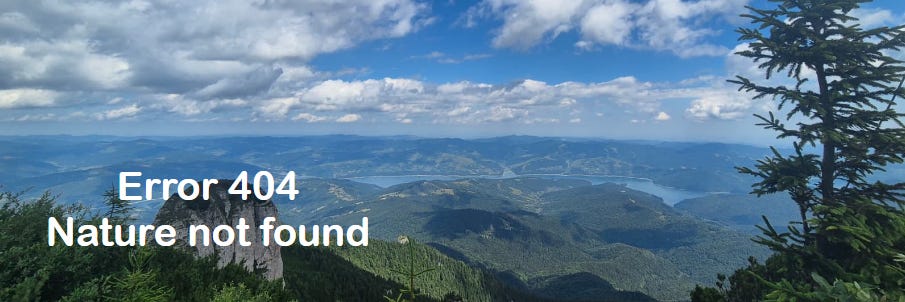
‘Ah, the beauty of Carpathian nature!’ If that came to your mind while looking at the photo above, I can’t blame you. Indeed, I’d say pretty much the same, since this is a landscape close to the village of my childhood. The only issue? Nothing that you see in that picture is ‘natural’.
If we define nature as environments untouched by humans, then most of the features in the photo are not natural, for that is an environment heavily managed by humans, more akin to a city park than ‘virgin’ nature.
The empty specks of land are used for plant agriculture, shepherding or housing by humans. Most of the forests are second or third growth, since in many areas they have been completely cut for commercial purposes and then replanted. Indeed, my father and grandfather were some of the workers who did the cutting, and it is now my turn to plant the seed of a better relation to wilderness.
The lake at the centre of the photo is also not natural but was built during the Communist era to generate electricity. Indeed, even the national parks in the area are ‘natural’ only because the Romanian government has decided to heavily restrict human access.
The word ‘nature’ can also be used to mean a way of life closer to that of our ancestors. But this more ‘natural’ living is quite a misuse of the word – as a former shepherd, I can assure you that everything was quite thoroughly planned by humans: from planting the crops to clearing land for grazing and hay, from building houses with local materials to killing ‘pests’.
Indeed, during my childhood we’d sometimes see nature as bountiful when we foraged for berries and mushrooms in the summer. But more often than not, nature was something we had to fight and tame in order to survive. So ‘natural’ living is usually quite the nonsensical and misleading phrase that should be replaced with ‘traditional methods’ or ‘village life’ or ‘pastoral beauty’.
We have seen how even landscapes that look ‘natural’ are often created, changed and managed by humans. With over 8 billion of us around, it is increasingly difficult to find corners of our planet free of human touch. So that this strong distinction between the ‘human’ and the ‘natural’ should be abandoned.
Now, the most important reason for that doesn’t even have to do with the term being often used incorrectly or in quite the unclear ways. This is a helpful illustration, but it wouldn’t be such an issue if this was just a descriptive error.
The issue comes from the spiritual load of the word, so to speak. In clearer terms, the problem is with viewing everything natural as good and everything made by humans as suspicious. This is not a rational view of the world but a devotional expression and, in worse cases, an outright scam (or, as they are known nowadays, marketing campaigns).
And while spending time in green places, connecting with nature and wanting to protect beautiful areas can often be healthy, the unreflective preference for the ‘natural’ is often directly followed by harms to humans and other animals. Understanding just how little of the world around us is natural, in the sense of not being touched by humans, can be the first step in preventing some of the harms this view of things brings.
The dangers of this idealistic view of nature are best illustrated with examples of which, unfortunately, we find in abundance. So let me split them into three categories:
1. Harms to humans
The fuzzy claim that ‘natural = good’ and ‘anything artificial or human-made = bad or suspicious’ has been employed to support quite a lot of ideas that resulted in preventable human deaths and misery. Stijn Bruers lists more than 10 such examples in an excellent article, with the most important being the anti-GMO and anti-vaccine attitudes.
While a dose of scepticism about modern technology and government programmes is healthy, opposing something just because it is ‘unnatural’ is the opposite of health. It is an irrational fear and one should always be suspicious of people who use this as their main argument.
If the examples above are too sensitive for people who do not know what media literacy is, the next one should be a clearer case of how the unreflective preference for nature can harm humans. I found this case in Manu Joseph’s excellent book Why the Poor Don’t Kill Us? In there, he discusses how leopards in India kill dozens of people every year, not to mention cattle and pets. Since big cats are protected by law and cannot be culled, forest officials capture and release them back into ‘nature’.
‘’But the leopards kept returning, with their friends and lovers. They loved the place. The sugarcane farms provided good cover, and as it was one of the most irrigated places in the state, there was abundant water. And, of course, there were cattle and dogs, and little unattended humans.’’
‘’India’s laws that protected the leopards were exemplary, correct, moral, and very wise. But the villagers who faced the threat every day could not afford to be so noble.’’
Now, of course, part of this might be due to the fact that the ‘natural’ environment of the big cats had been diminished, but as Manu Joseph states, ‘’the fact is that there is no such thing as a ‘natural’ habitat. The leopards (and also the lions in some regions of Gujarat), are increasingly showing that their ‘natural’ habitat is wherever there is abundant food.’’ And, elsewhere, he mentions how ‘’it is possible that a whole generation of leopards have never seen a forest; they were born in the sugarcane farms and grew up in the region.’’

2. Harms to farm animals
Claiming that veganism is not natural has been used as slander for years and has resulted in the obvious misery and deaths of the animals bred and sacrificed for supposedly more ‘natural’ lifestyles. As if anything about the modern farming practices were natural…
And don’t even get me started with traditional farming! As a former shepherd from rural Romania, I don’t see how controlling every aspect of a farm animal’s life counts as natural (forcing the cows to breed with the biggest bull in the area; chaining dogs; using horses for forest work, etc.).
But times are changing: horses have been replaced with tractors; fewer people are keeping dogs chained for their whole lives and it is now more common to buy meat from the shop because it is cheaper and easier than growing pigs in the backyard. So that wanting people to return to past practices is not an argument for ‘natural’ life; rather, it is the romanticisation of poverty and needless toil.
Despite the progresses mentioned above, when it comes to the eating of meat, the issue did not improve from a moral point of view; rather, the animals were moved from backyards and pigsties to modern factory farms where no one can hear their screams any more. It is then the height of hypocrisy from people who consume supermarket meat to label vegan alternatives and clean meat (lab-grown) as unnatural.
I’ve written more on traditional animal farming here:

3. Harms to wild animals
Another area where the idyllic view of nature does a lot of harm is in nature itself. That is, when we think of nature as something good by definition or a place that humans should stay out of, we also give up on helping wild animals.
This approach to environmentalism and wild animals is to an extent understandable when we remember the history of our species and the many many ways in which humans have harmed wild animals. But it also means giving up the fight without even trying, especially when some interventions in nature are quite easy to do. Not to mention how it is quite the uncharitable view of our species: yes, we are right to fear our worst impulses, but progress in social matters was not achieved by doing nothing.
Some interventions in nature are both very cheap and can make a huge difference. Examples include placing salt blocks for deer and other mammals; designating certain areas as national parks; vaccinating wild populations, especially bigger mammals; feeding seeds to wild birds during winters.
Of course, helping wild animals is not always easy and it might sometimes lead to conflicts such as the leopard one mentioned earlier. But not all important things in life are easy. The easy thing is to say that humans should not intervene in nature, but that is little more than pretending the problem doesn’t exist.
Those who want to read more about the ethics of human intervention in nature can start by checking the essay A Peopled Wilderness by the very influential and cool contemporary philosopher Martha Nussbaum. In there, she argues that
‘’freedom and autonomy for animals are not incompatible with intelligent human stewardship. Indeed, they typically require stewardship, because Nature is not a glorious site of freedom. If humans try to renounce stewardship, in a world where they are ubiquitously on the scene, shaping every habitat in which every animal lives, this is not an ethically defensible choice or one that promotes good animal lives. The only options before us, in the world as it is, are types and degrees of stewardship. We need to face this fact head-on, or else we will not have a good debate about how to exercise the power that we indubitably have.’’

Conclusion
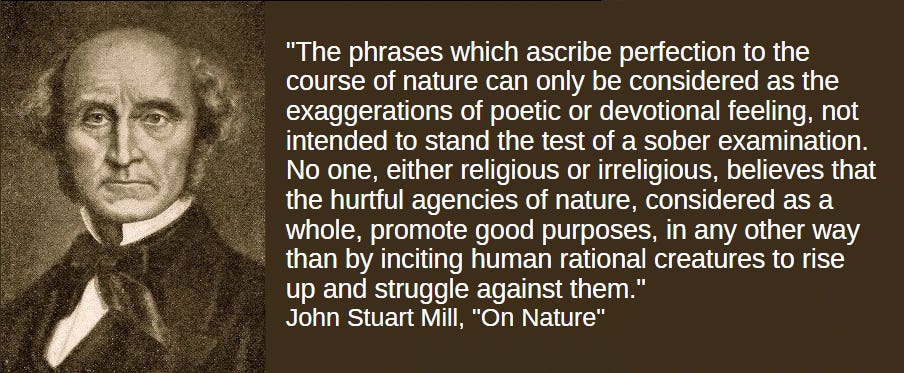
There is more to say about the way in which we use the word ‘nature’, but this is a short article, not an essay. And John Stuart Mill did already quite the good job in discussing the matter a long time ago, especially by mentioning how the appeal to nature in morals and justice has been a fallacy that has plagued Western thought since antiquity.
Mill also mentions how the expression “laws of nature” has a double meaning. It is first used in a scientific way for things such as gravitation and other laws of physics. And second, it is used to “to express what ought to be”–that is, the ethical standards or rules people should use in their lives.
There are no immovable laws in nature that can tell us how to live a good life, but many people still want to find them. I suppose the idea of some clear standards embedded in the universe itself can be more attractive than the opposite: it is up to humans to organise their lives and societies. Heck, believing in some unchanging laws of nature might even bring some security or consolation, but this is the consolation of an old woman from a violent patriarchal society who has no control over her life.
For the rest of us, lucky enough to live in freer countries, the knowledge that institutions and moral codes are made by humans is a liberating one, since what was made by human hands can also be changed by human hands.
A last point of clarity here is that I do not claim ‘nature’ overall doesn’t exist. Rather, there is little or no nature untouched by humans, and the few patches of wild lands still around exist precisely because humans have decided to keep them so.
The human and non-human spheres are so connected that indeed they have become one. So that using ‘non-human nature’ as the standard for human (!) morals is now doubly mistaken: not only is it a logical fallacy, but a factual one too, since ‘virgin nature’ does no longer exist. In such a situation, ignoring wild animal suffering or claiming humans should never intervene is the same as allowing children to die of measles because vaccination is not natural.
Now for the people who still need a spiritual connection to nature or ancient thought, do not fret. Recognising just how interconnected the human and non-human spheres is actually closer to the ancient view that saw humans as just another part of nature, on somewhat of an equal footing with the elements, animals and plants (or, in any case, saw other parts of nature worthy of moral respect). It is with the rise of Abrahamic religions and modern hubris that the natural and human spheres have been so thoroughly separated in our minds.
That’s all for this article. Do let me know what usage of the word ‘nature’ do you find most confusing or harmful.
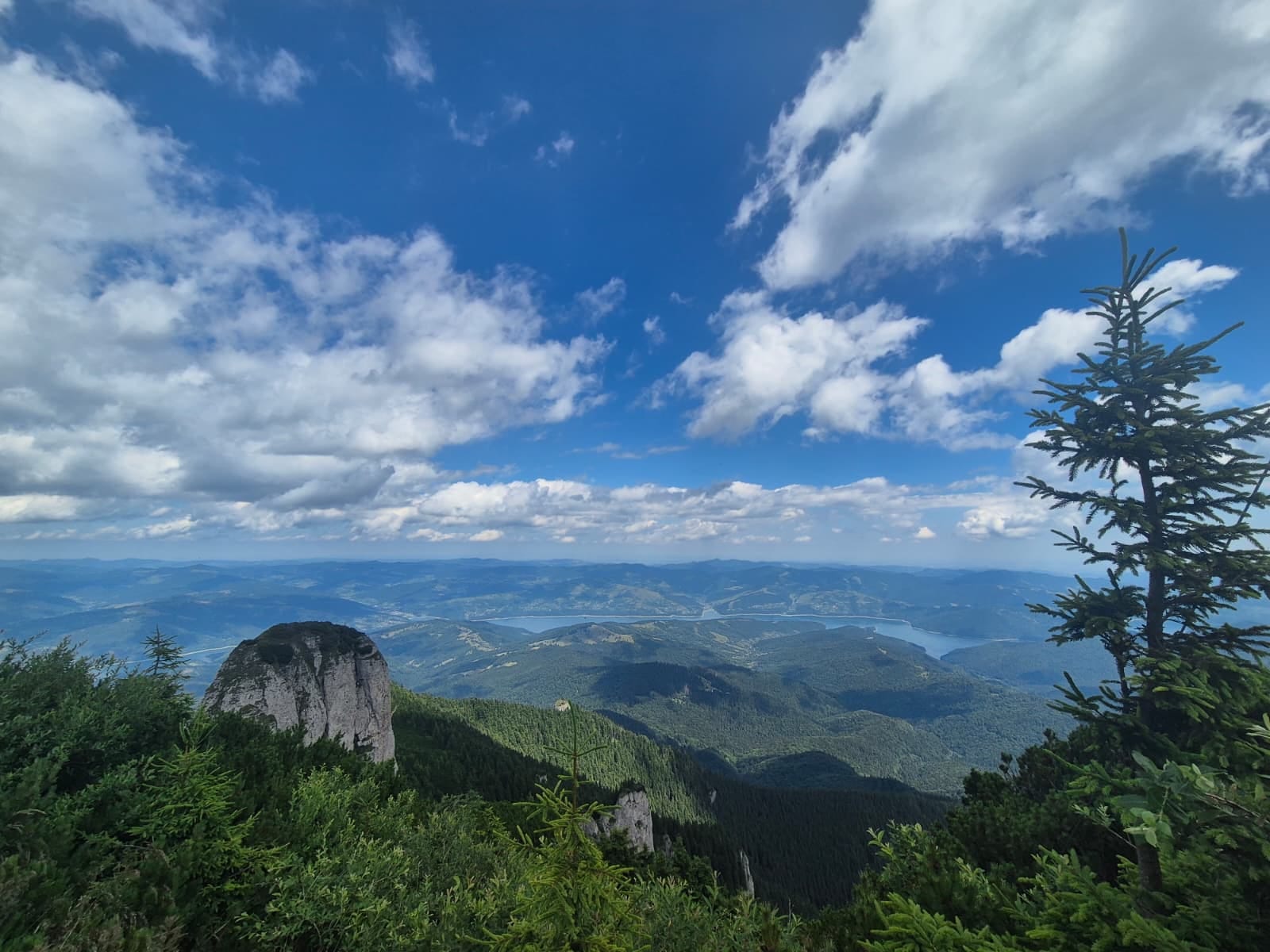
I am very thankful to Daniela B. for the lovely picture taken on the Ceahlău Masiff. Here is the whole of it:
Time for some references:
I’ve expanded on the ancient view of animal ethics in the article Socrates’ shepherd published for Daily Philosophy. For a similar theme, you can also check Where are all the ethical omnivores?

On nature:
Bruers, Stijn. “Why Naturalness Is Irrational and Harmful.” The Rational Ethicist, 2018. Link here.
The essay ‘’Nature’’ from Mill, John Stuart. Three Essays on Religion: Nature, The Utility of Religion and Theism, London, 1874. Link here.
Horta, Oscar. ‘’Debunking the idyllic view of natural processes. Population dynamics and suffering in the wild.’’ Télos, 2010. Link here.
On wild animal ethics:
Nussbaum, Martha C. ‘’A peopled wilderness.’’ 2022; The New York Review. Archived version here.
Pearce, David, ‘’High-tech Jainism.’’ Abolitionist.com. Link here.
Faria, Catia. Animal Ethics in The Wild. Wild Animal Suffering and Intervention in Nature, Cambridge, Cambridge University Press, 2023
Great points. Of course, we are Nature and there is no separate entity. However, it is useful to use the term Nature so that other species can live. Every species has a right to live in their habitat. However, the human enterprise has turned much of the biosphere into human artifacts. So, we tend to talk about Nature in that sense. People need to leave space for wild species because they have nearly disappeared. Human population overshoot is the driver of these symptoms including our use of the word “Nature”.